Published: November 2025
By: TheGRIN.io Editorial Team
Theme: Expanding Signals — Culture, Tech & Cosmos
Signals from the Cosmos
This issue of Global Notes explores how science, art, technology and community initiatives are expanding our understanding of the world and our place within it. From fundamental physics and space phenomena to the health benefits of looking at art, from AI‑driven creative tools to citizens’ assemblies running cultural institutions, the stories in GNOTES5 highlight the ways humanity is reimagining reality and culture. Each section below offers key insights and links to the original articles.
Community & Society

- Buena ondo! Meet five Latin American artists leading the way with colour, culture and good vibrations – Creative Boom spotlights five illustrators from Mexico and Brazil whose work radiates colour and positivity. Artists like Beatriz Gutiérrez Hernández, Mel Cerri and Axel Rangel Garcia blend folk motifs, surrealism and street art to celebrate Latin American culture and spread “good vibes”. Their styles showcase the region’s diversity and global impact.
- The art of the possible: the Nottingham art gallery being run by citizens’ assembly – In Nottingham, the New Art Exchange gallery is governed by a diverse citizens’ assembly of 40 local residents representing 52 languages. They decide how to allocate the gallery’s budget, transform spaces (replacing a street‑level gallery with a café) and have increased engagement and representation significantly.
- Back to the Future: Why Audi, BMW, and Mercedes Are Revisiting Classic Designs – Luxury carmakers are embracing retro design to evoke comfort and continuity in turbulent times. Mercedes’ Vision Iconic concept references 1950s sports cars, Audi’s Concept C adopts vertical front ends, and BMW reinterprets historic grilles. The trend connects tradition with electric‑vehicle technology and reassures consumers.
Signals: Community & society stories explore how collective action, nostalgia and cultural pride shape contemporary life. Democratic governance models at art institutions empower local voices, retro aesthetics connect consumers to heritage, and Latin American artists export vibrant cultural narratives worldwide. Together, they highlight the importance of participation, identity and joy in reimagining society.
Science & Technology

- 3I/ATLAS: Why the comet from another world continues to baffle – Discovered in July 2025, 3I/ATLAS is only the third known interstellar object and exhibits unusual behaviour such as non‑gravitational acceleration and dramatic colour changes. Some speculate about alien origins, but astronomers say it is a natural comet that challenges our understanding of interstellar visitors.
- Nike’s first neuroscience‑based footwear “designed from the brain down” – Nike’s new Mind 001 and Mind 002 shoes use 22 foam nodes to stimulate sensory receptors in the foot, aiming to create a calming and focused state for athletes. The shoes result from a decade of research by Nike’s Mind Science department and will launch in early 2026.
- Mathematical proof debunks the idea that the universe is a computer simulation – A team of physicists argue that the universe cannot be a computer simulation because the most fundamental laws of nature are non‑algorithmic. Their mathematical proof shows that no algorithm can fully describe reality, pushing back against the popular “simulation hypothesis”.
- Solar energy is going to power the world much sooner than you think – Rapid cost declines and exponential deployment of solar‑PV systems mean solar could soon become the world’s dominant energy source. Analysts note that emerging economies are driving demand, although storage and grid integration remain challenges.
Signals: Science and technology stories this week reveal a fascination with fundamental questions and practical innovations. We see researchers challenging the notion that reality is a simulation, solar power poised to overtake fossil fuels, interstellar comets raising fresh questions, and neuroscience informing product design. Together, they signal a future where curiosity, sustainability and mind–body connections drive innovation.
Health & Art

The Costume of Painter – at the studio-hm in the red m, 2020Gallery Grimson
- Looking at art reduces stress, according to a major scientific study – In a controlled trial at The Courtauld Gallery, participants who viewed original artworks saw a 22 % drop in cortisol levels, compared with 8 % for reproductions. Researchers found that viewing art improves immune, endocrine and autonomic systems and increases emotional arousal.
- Could art be as good for your health as exercise? – This report describes a World Health Organization‑supported Lancet series exploring the health benefits of the arts and a museum prescription programme in Canada. Evidence suggests that arts engagement can help treat non‑communicable diseases and improve social well‑being.
Signals: The health & art section underscores growing evidence that cultural experiences benefit both body and mind. Scientific studies show art viewing measurably reduces stress, while global health bodies and museums are exploring arts‑as‑medicine initiatives. Culture is not just enriching – it is good for us.
Creative Tech & Culture
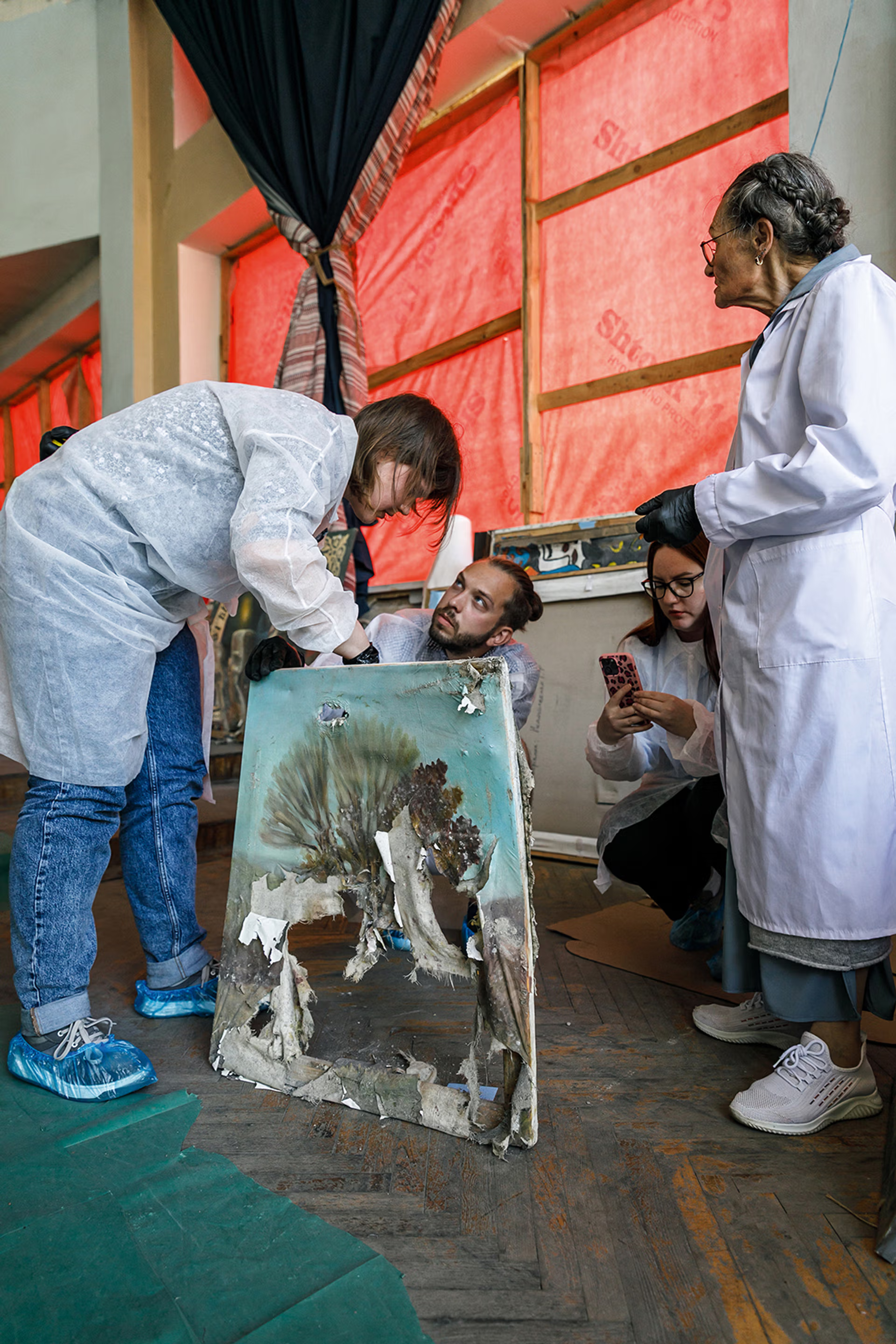
Photos: Bohdan Poshyvailo, archive of the Maidan Museum/ACURE
- ‘Proof that life goes on’: meet the people rescuing and re‑energising Ukrainian culture – The Art Newspaper profiles the Nahirna 22 arts collective and the Mykhailo Boychuk Academy, which continue producing art despite bombings. Rescue teams have salvaged over 560 artworks, festivals such as BoychukFest celebrate recovery, and a public installation at Kyiv’s main station symbolizes Ukraine’s cultural motion.
- Adobe puts AI in everything, everywhere, all at once – Adobe has integrated generative AI across its Creative Cloud suite. New tools include Firefly for background music and voice‑over generation, an AI object mask tool in Premiere Pro, a web‑based video editor, and conversational chatbots inside Photoshop. According to Adobe, 86 % of creators already use AI, though pricing and copyright issues remain unresolved.
- The Grand Egyptian Museum is now complete – The new Grand Egyptian Museum, aligned with the Pyramids of Giza, will showcase over 5,000 artefacts. Designed by Heneghan Peng Architects, the building features radial walls matching the pyramids’ angles, a monumental staircase lined with statues, natural lighting and 17 conservation labs.
Signals: Creative tech and culture stories show how innovation can fuel both creation and preservation. AI is transforming creative workflows, while architectural feats like the Grand Egyptian Museum blend ancient history with cutting‑edge design. Meanwhile, Ukrainian artists and institutions demonstrate resilience by saving and re‑energising their heritage despite war. This section underscores technology’s dual role: enabling new forms of creativity and safeguarding cultural legacy.
Resonance: What the Signals Tell Us
GNOTES5 illustrates how curiosity, creativity and community intersect to expand our understanding of reality and culture. From mathematicians challenging the simulation hypothesis to citizens’ assemblies running galleries, the issue demonstrates that progress often comes from questioning assumptions and working together. As solar power surges and art prescriptions become mainstream, the boundary between science and art blurs. Innovations like AI‑powered creative suites and neuroscience‑informed shoes show technology’s potential to enhance everyday life. Meanwhile, cultural resilience in Ukraine and Latin America reveals art’s power to heal and unite. The signals in this issue encourage us to stay engaged, curious and compassionate as we continue to explore a rapidly changing world.
Written by Thristian for TheGRIN.io
Reference Code: GNOTES5
Series: Global Notes Weekly — Published every Wednesday